Monday, November 7, 2011
Perseverance
A couple of weeks ago Linda and I attended a seminar hosted by the Dalai Lama Centre with Margaret Wheatley, a highly regarded organizational theorist and leadership consultant. Her recent book is entitled - Perseverance - Leadership in Turbulent Times. The topic definitely seemed timely. She framed her comments around a metaphor drawn from a Hopi prophesy that essentially says that in the presence of a fast flowing river, the people who are clinging onto the shore will be ripped apart whereas those who move into the river, keep their heads above water, keep their toes pointed downstream and look out for those with them will persevere. Take a look at this YouTube clip on Perseverance. It is a great time for all of us to think about how we support the ones around us and the ways in which we are moving ahead in support of all our learners - no matter what.

Tuesday, November 1, 2011
Lansdowne Middle School - Hooks Readers
Last year the NPBS team at Lansdowne Middle School in Victoria developed a unique approach to hooking kids on reading by having them develop on-line book flyers. Check out the wiki created by librarian Jane Spies to see what the learners had to say about this engaging experience. Thanks to the team at Lansdowne for sharing this strategy.
Friday, October 28, 2011
BC Innovative Learning Environments
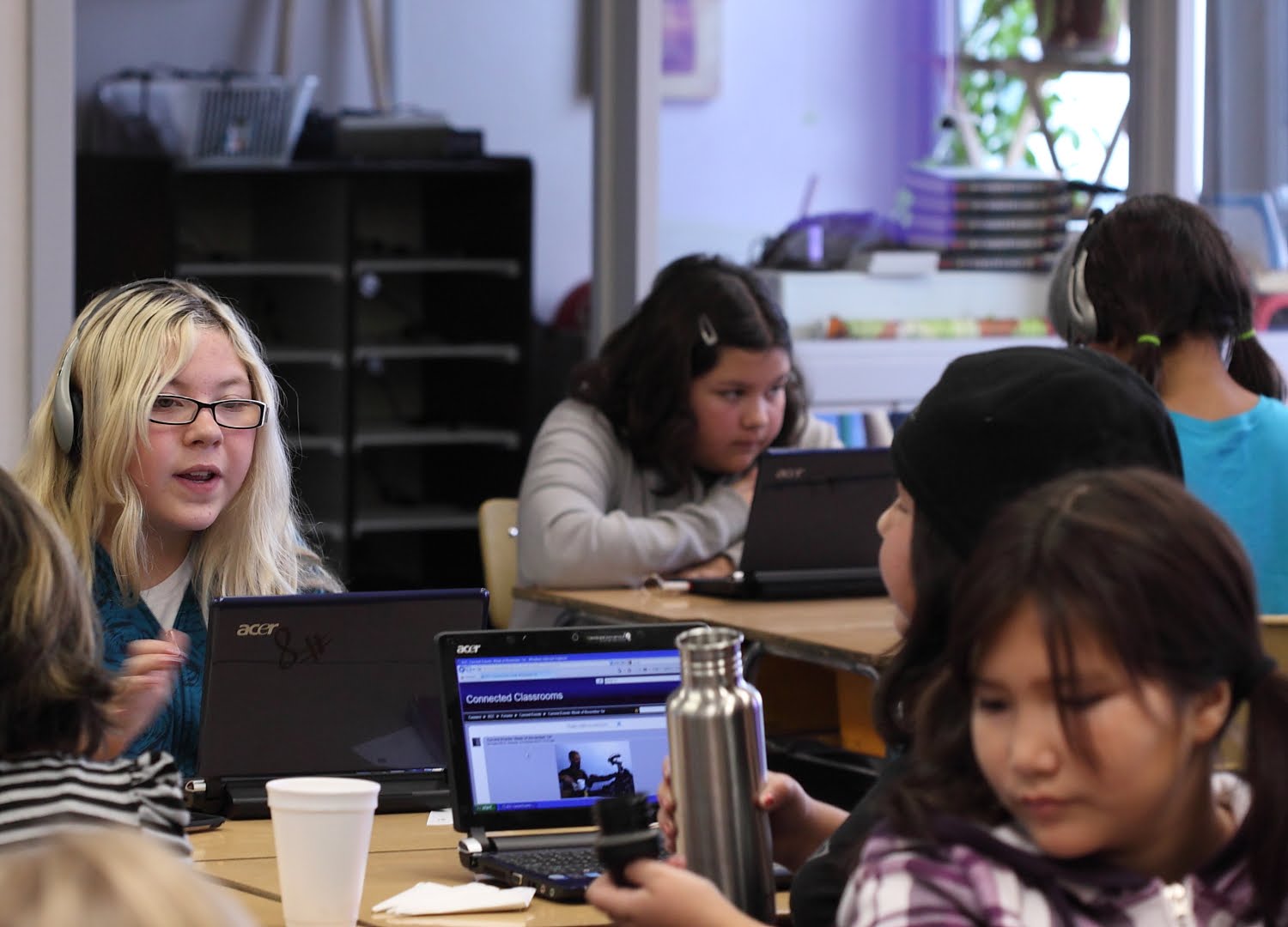 Connected Classroom - Gold Trail
Today the Ministry released the new Education Plan. At the heart of the plan is the focus on learners owning their own learning - and the challenge of designing more responsive, flexible systems to meet the needs of all learners. There are important linkages between the goals of the Education Plan, the focus of the on-going inquiry work in Network schools and the exciting number of truly innovative learning environments that are being developed across BC.
For the past two years, Linda and I have been part of an international projects sponsored by the OECD on Innovative Learning Environments. This project involves representatives from 25 countries identifying promising local case studies, some of which are selected for inclusion in a set of international cases and then a few of which will be the subject of more in-depth research.
Last spring we submitted six case studies from BC - and we could have submitted a lot more. Over the next few months, we will be continuing to identify promising case studies and inviting representatives from those learning environments to participate in this project. No money or glory involved - this is simply a chance to get the great work in BC understood and recognized on an international platform. To be accepted into this project, the learning environment has to be designed in response to a significant learning need, it must consider the use of time and space in new ways, and connections across the curriculum and with the community are built in.
One of the BC case studies that has been accepted into the 'universe' of international cases is the Connected Classroom in the Gold Trail School District. Three intermediate classrooms are linked by technology and are creating strong social-emotional connections across geographically remote communities. Check out a video clip to see the excitement on the part of the teachers and the learners. Not only is this a great example of innovation and creative thinking, we also think it is a strong example of the five elements indicated in the Education Plan.
Stay tuned for other examples from BC - and from around the world.
Wednesday, October 5, 2011
Every Learner is a Somebody

At a fund raising event last fall at Alberni Elementary School, a grade one student was overheard saying: "Why do we have to do this? It's not like we're going to make a difference." This sparked discussion among the staff about the ways in which personal beliefs and attitudes dictate personal actions. Out of this, their Network question emerged and they spent a productive year working to equip their learners with the tools, attitudes and beliefs that would encourage genuine community participation. Their observations about the changes in student behaviour and anecdotal feedback from parents told them they were on the right track. The differences in response between their Aboriginal and non Aboriginal learners raised even more questions and they are now seeking out ways to help each child become more aware of their valuable role in the life and care of their classrooms. We think there are lots of schools who would be interested in the specific ways in which the teachers at Alberni are tackling this question.
The best practices in the world are evident in BC schools - in some places, at some times, and in some situations. Through the Network we have been working hard to find ways and spaces where we can learn from each other and build on the great work that is taking place in schools across the province. We really believe that if we work together in a spirit of generosity and inquiry, dig deep into our own practices, look around to see what we can learn not only from the most current international research but also from cutting edge practice in BC schools, that we can truly improve the life chances of every learner.
Over the summer, a team of Network volunteers read the hundreds of case studies submitted from NPBS and AESN schools. All the case studies will soon be available on the Network website and we hope that you will take the time to explore what is happening in these inquiring schools. We have put together a small set of Sample Case Studies that contain the stories of inquiry, innovation and improvement from schools from Comox Valley to Vernon, Nechako Lakes to Invermere and everywhere in between.
Network schools agree to share their strategies, ideas, resources, triumphs and challenges openly and freely. We ask that if you learn something from a Network school or if you use resources or programs developed by colleagues in another school, that you will acknowledge the source. So, thanks to the team at Alberni Elementary for sharing their successes with helping to ensure that every child feels like a somebody - a somebody who can make a difference.
Wednesday, September 28, 2011
Assessment resources
Over the past few years a number of assessment resources have been developed provincially including webcasts involving several NPBS educators. They are now readily available on the West Vancouver School District website.
Monday, June 13, 2011
Awards, recognition and a growth mindset

Does every student in your school have two adults who are crazy about them?
June is the time of year when family members cram into school gyms and auditoriums to celebrate the accomplishments of their young scholars, athletes, and citizens. School awards ceremonies are steeped in tradition and to question the way we recognize our learners can bring out all kinds of emotions.
We know there is an on-going debate about how we recognize excellence and effort - and the extent to which awards ceremonies reinforce what Carol Dweck refers to as a fixed mindset (my abilities are inherent – “I am rotten in French, so was my Dad”) or encourage a growth mindset (I can get better at anything with effort and support – “If I work hard at Math, I know I will improve”). Dave Bartley, Principal with his Star
We watched as “Tom”, hat on backwards, looking down at his feet, heard his teacher say how proud she was of the positive changes he was making in his behavior and how pleased she was to see that he was growing into a fine young man. We watched him stand just a little bit taller and a hint of a smile creep onto his face. We heard another teacher read a poem he had written about “Candace” a young girl with unique learning needs who made his day, every day, by asking how he was – and then listening to hear the answer. Candace glowed as he acknowledged her kindness.
Whether or not this approach to awards will work everywhere is not the point. What does matter is that for this evening, in this school, with the dedication of these teachers, these young people know what it like to have at least one adult who is crazy about them. And maybe, just maybe, they will begin to see themselves as real stars.
Network Reflections and Impact
Over the last few weeks, celebrations of networked learning have been held in twelve sites around the province. Linda and I were able to attend several and in every spot, we were deeply impressed with the quality of the work, the focus on learners owning their own learning, the teamwork across roles, and the dedication and commitment of all of you to achieving our shared vision of EVERY learner crossing the stage with dignity, purpose and options. We have seen countless examples of the positive impact of formative assessment and the confidence learners demonstrate when they can answer the three key questions: Where are you going wih your learning? How is it going? and Where to next? We came away from both the seminar and the celebrations more convinced than ever about the power of networked inquiry to create both quality and equity.
Later this month, along with some Network colleagues, we are meeting with the Minister of Education to share some of our observations about the impact of the Network. We would welcome any observations that you would like to share and invite you to post or email us your comments.
Subscribe to:
Posts (Atom)